

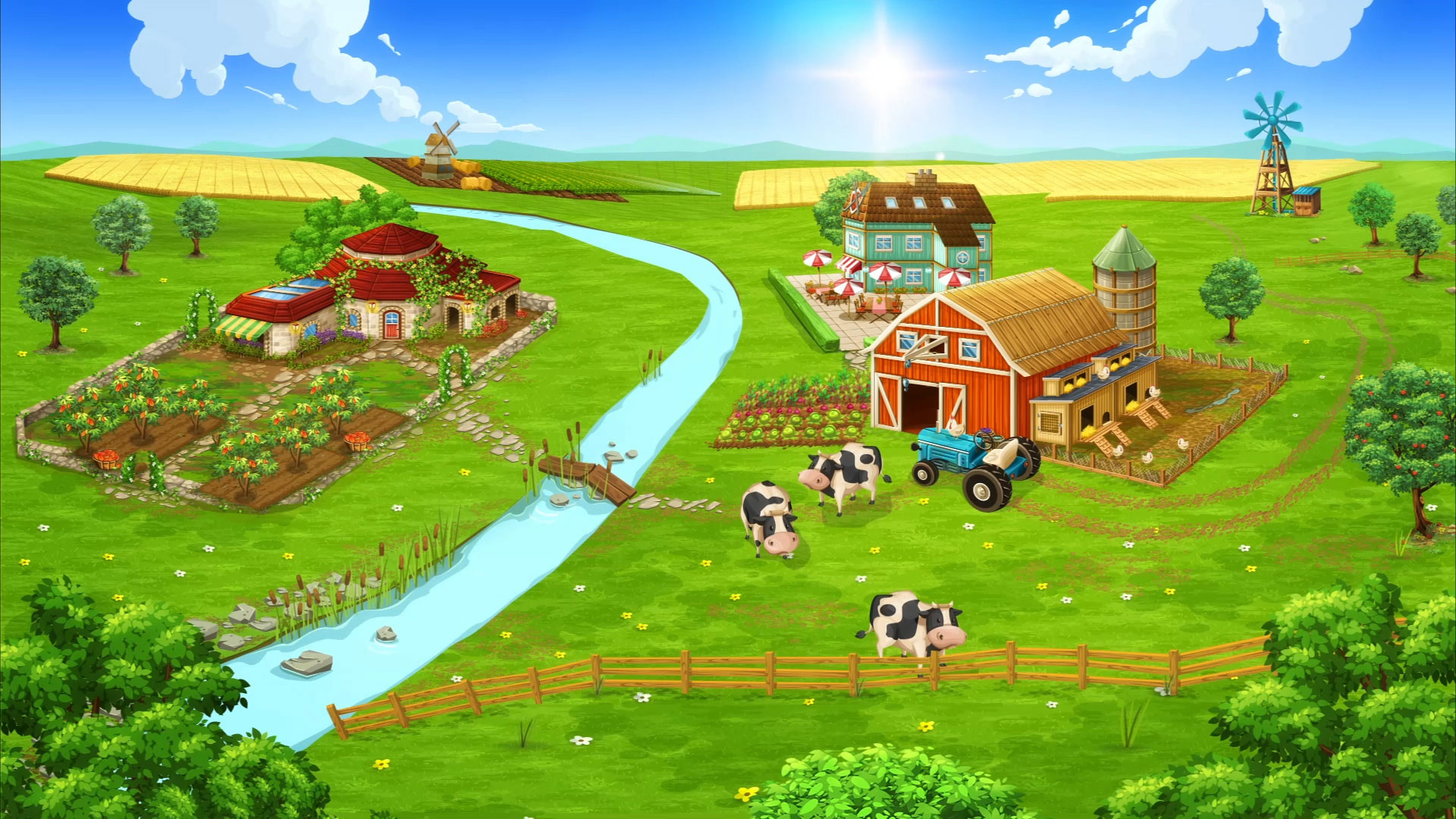
Few gaming genres have captured the collective imagination of players across every demographic, every platform, and every corner of the world with quite the sustained warmth and the deeply satisfying appeal of the farming simulation game — a category whose combination of creative freedom, gentle progression, satisfying resource management, and the specific pastoral pleasure of building something beautiful and productive from a patch of virtual land has made it one of the most universally beloved and most consistently popular gaming genres of the past two decades. Farming games occupy a unique psychological space in the gaming landscape — they are the antidote to the urgency and the anxiety of action games, the complexity fatigue of strategy games, and the social pressure of competitive multiplayer titles, offering instead the specific comfort of a game whose pace is entirely the player’s own, whose challenges are achievable without exceptional skill, and whose rewards accumulate pleasurably across hours of genuinely relaxing, genuinely productive virtual agricultural activity. The genre’s appeal crosses every demographic boundary with unusual effectiveness — drawing in young players discovering the satisfaction of nurturing and building for the first time, adults whose real-world demands make the peaceful, controllable world of a virtual farm a genuinely therapeutic escape, and dedicated gaming enthusiasts whose engagement with the genre’s deeper systems of seasonal planning, crop rotation, animal husbandry, and the social dimensions of farming community games reveals the considerable depth beneath the genre’s apparently simple surface. This guide explores the most popular, most acclaimed, and most enduringly beloved online farming games available across every major platform — examining what makes each distinctive, which aspects of the farming simulation experience each delivers most effectively, and what specific pleasures each offers to the players who have made the genre one of the most commercially successful and most personally meaningful in the entire gaming landscape.
Stardew Valley: The Independent Farming Game That Conquered the World
Stardew Valley is not merely the most popular farming simulation game of the modern era — it is one of the most remarkable stories in the entire history of video game development, a game created almost entirely by a single developer over four years of solitary work that upon its release in 2016 became an immediate critical and commercial phenomenon whose player base continues to grow nine years later, driven by the extraordinary depth, the exceptional warmth, and the specific quality of the experience it provides to every player who discovers the fictional Pelican Town and the abandoned farm whose restoration and development forms the game’s central creative and narrative journey. The game’s achievement is the creation of a farming simulation whose systems — the seasonal crop cycle, the mine exploration for ores and gems, the social relationships with the town’s resident characters, the artisan production of processed goods, the fishing, the foraging, and the eventual development of the farm into a productive, beautiful, and personally expressive homestead — are individually deep enough to sustain sustained engagement and collectively integrated tightly enough to create the specific quality of a coherent, living world rather than a collection of disconnected mechanics.
The crop cultivation at the heart of Stardew Valley’s farming loop rewards the planning and the seasonal awareness that genuine agricultural logic requires — different crops grow in different seasons, take different numbers of days to mature, have different gold-per-day values when compared against their seed cost and growing time, and reward the player who plans their planting schedule against the available days in each season with consistently stronger financial performance than the player who plants randomly without strategic consideration of the seasonal calendar and the crop economics. The artisan goods system — the kegs, the preserves jars, the cheese presses, and the full range of processing machines whose input of raw farm products produces the higher-value processed goods that represent the most financially productive use of the farm’s output — adds the economic depth that transforms farming from a simple planting and harvesting loop into a supply chain optimisation challenge whose satisfying complexity is available to players whose engagement with the game extends into the medium and later stages of the farm’s development.
The online multiplayer mode added to Stardew Valley after its initial release allows up to four players to share and jointly develop a single farm — creating a cooperative social experience whose specific dynamics of shared resource management, division of labour, and the negotiation of different players’ aesthetic and strategic preferences adds the social dimension that transforms a solitary contemplative experience into a genuine shared creative project whose memories of collaborative building and joint celebration of farming milestones represent some of the most warmly remembered gaming experiences in the community of players who have shared a Stardew Valley farm with friends, partners, and family members whose collective investment in their virtual agricultural enterprise reflects something genuine and genuinely touching about the human desire for the shared creative activity that the best cooperative games facilitate so naturally and so beautifully.
Hay Day: The Mobile Farming Phenomenon That Defined a Genre
Hay Day — the mobile farming simulation developed by Supercell and released in 2012 — became one of the most commercially successful and most widely played mobile games of the smartphone era, establishing the template for the mobile farming game whose colourful art style, satisfying production chains, social trading mechanics, and the specific free-to-play progression model whose daily return incentives and social neighbourhood features create the habitual engagement that has sustained its enormous player base across more than a decade of operation. The game’s achievement in the mobile farming genre is the creation of a farming experience whose core loop of producing goods, trading with other players, and expanding the farm’s capabilities is sufficiently deep to sustain long-term engagement while remaining accessible enough to be genuinely playable in the short sessions that mobile gaming most commonly involves.
The production chain mechanics that define Hay Day’s farming gameplay — in which the player manages the supply of raw ingredients including crops, animal products, and foraged items through an increasingly complex network of production buildings whose outputs are either sold directly for coins or processed further into higher-value finished goods — create the satisfying resource management challenge that characterises the best farming simulation games at every level of complexity. The wheat that grows in the field becomes the flour that the mill produces, which in turn becomes the bread that the bakery bakes, which can be sold at a premium in the roadside market or contributed to the neighbourhood cooperation tasks whose completion earns the collective rewards that make the social dimension of Hay Day’s gameplay system genuinely valuable rather than merely cosmetically present. The social trading market — whose player-to-player exchange of goods at player-set prices creates the specific economic ecosystem that differentiates Hay Day from purely solo farming experiences — adds the human interaction dimension whose presence in a mobile farming game is both commercially valuable for the developer and genuinely enjoyable for players whose delight in finding a sought-after good at a bargain price or selling an overpriced item to an inattentive buyer reflects the specific pleasure of a player-driven market whose dynamics are unpredictable in ways that algorithmically managed in-game economies never quite replicate.
Farming Simulator Series: The Realistic Agricultural Experience
The Farming Simulator series — developed by Swiss studio Giants Software and released in annual or biennial editions since 2008, with the most recent major entry Farming Simulator 22 and its successor Farming Simulator 25 continuing the series’ trajectory of expanding content, improving visual fidelity, and deepening the authentic agricultural simulation that has made it the definitive realistic farming game franchise in the industry — occupies an entirely different position in the farming game landscape from the gentler, more abstracted simulation experiences of Stardew Valley and Hay Day, offering instead the most detailed, most technically accurate, and most comprehensively equipped virtual agricultural experience available on any gaming platform. The series’ appeal lies not in the pastoral charm or the social warmth of the lifestyle simulation genre but in the authentic satisfaction of operating real-world agricultural machinery — the licensed tractors, combines, implements, and vehicles of manufacturers including John Deere, Case IH, New Holland, Fendt, and dozens of other real agricultural equipment brands whose faithful digital reproductions in the game provide the specific pleasure of equipment enthusiasts whose knowledge of and appreciation for agricultural machinery is a significant component of their engagement with the series.
The gameplay of Farming Simulator encompasses the full cycle of realistic arable and livestock farming — the ploughing, cultivating, sowing, fertilising, crop protection application, and harvesting of the various crop types available in each edition’s content library, the transportation of harvested crops to sell points, the management of the financial flows whose balance determines the farm’s investment capacity for machinery and land expansion, and the management of the livestock enterprises including cows, sheep, pigs, and horses whose feeding, care, and productivity management adds the animal husbandry dimension to the predominantly arable focus of the core farming loop. The multiplayer functionality that allows up to sixteen players to share and operate a single farm simultaneously creates the specific cooperative experience of a working farm team — different players operating different machines in a coordinated harvest operation, one player hauling grain while another continues combining, a third managing the machinery maintenance and the field work planning that keeps the operation running efficiently — whose organisational satisfaction and social enjoyment represents one of the most distinctive and most enthusiastically described experiences in the online farming simulation genre.
Animal Crossing: New Horizons — The Social Island Life That Redefines Farming Games
Animal Crossing: New Horizons occupies a unique position in the gaming landscape — a game that is not strictly a farming simulation in the conventional sense but whose extensive fruit tree cultivation, flower breeding, vegetable growing, and the broader nature management of the player’s island environment create a farming-adjacent experience of sufficient depth and sufficient pastoral pleasure to make it an essential inclusion in any overview of the most popular online farming games. Released by Nintendo for the Nintendo Switch in March 2020 — at the precise moment when millions of people worldwide were entering pandemic lockdowns whose isolation made the game’s gentle, community-building, nature-celebrating island life an extraordinarily well-timed offering of comfort and gentle escape — Animal Crossing: New Horizons became one of the fastest-selling video games in history and the defining social gaming phenomenon of the pandemic era, whose cultural impact extended far beyond the gaming community into mainstream media and popular culture.
The nature cultivation elements of Animal Crossing — the planting and tending of fruit trees whose seasonal variation and whose role in the island’s economy as a source of tradeable produce provides the farming satisfaction within the broader life simulation framework, the flower breeding mechanics whose complex genetic system allows players to cultivate rare hybrid colour varieties through the systematic cross-pollination of parent plants, and the garden design whose aesthetic arrangement of flowers, trees, and hedges across the island’s terrain creates the specific creative pleasure of outdoor landscape design that gardening simulation fans find particularly compelling — together create a farming experience whose gentleness, whose beauty, and whose complete freedom from time pressure or failure conditions make it the most psychologically relaxing and the most creatively free farming-adjacent experience available in any game on any platform. The online multiplayer dimension of Animal Crossing — whose visiting mechanic allows players to travel between each other’s islands, to trade items including rare fruit varieties and hybrid flowers, and to appreciate the creative landscape design that each player has invested in their own island’s development — creates the social farming community experience whose specific warmth and generosity of spirit is one of the most genuinely distinctive qualities of the Animal Crossing franchise and one of the primary reasons for its extraordinary popularity across the demographic spectrum that farming and life simulation games attract more completely than almost any other gaming genre.
Sun Haven: The Fantasy Farming Rival to Stardew Valley
Sun Haven — the indie fantasy farming simulation developed by Pixel Sprout Studios and released in 2023 — represents the most ambitious and most critically acclaimed entry in the growing field of Stardew Valley-inspired farming simulations, offering a fantasy-themed farming and role-playing experience whose magical setting, extensive combat dungeon system, multiple playable races with distinct magical abilities, and the genuine depth of its farming, crafting, and social relationship systems create an experience of comparable scope and comparable quality to Stardew Valley while offering a sufficiently distinct aesthetic and gameplay identity to justify the sustained engagement of players whose appetite for the farming simulation genre extends beyond what any single game can satisfy. The game’s multiplayer functionality — allowing up to eight players to share and develop a single farm simultaneously — represents one of the most generous cooperative farming experiences available in the current gaming market and the feature that most directly differentiates it from the more limited multiplayer of comparable titles.
The farming mechanics of Sun Haven are built on the familiar foundation of seasonal crop cultivation, animal husbandry, and artisan production that characterise the genre, but their implementation within a fantasy world setting introduces the magical crop varieties, the enchanted farming tools, and the elemental resource systems that add the specifically fantasy dimension to the agricultural activities that the game’s world-building most directly expresses. The three distinct town settings — the human farming town of Sun Haven, the elven forest settlement of Nel’Vari, and the human-magical hybrid community of Withergate — each with their own resident characters, their own questlines, and their own specific crop and resource requirements, create the content breadth that sustains engagement beyond the initial farming establishment phase and into the extended relationship development and world exploration that the game’s role-playing elements reward across the many hours of its full content experience. The games and gambling entertainment value of Sun Haven — as a title whose blend of farming simulation depth, role-playing narrative, and the specific social pleasures of its multiplayer mode creates one of the most complete and most generously designed farming game experiences available in the current market — makes it among the most recommended new entries in the genre for players whose enthusiasm for farming simulations extends to the exploration of everything the genre’s most creative developers are currently producing.
Conclusion
Online farming games have established themselves as one of the most enduringly beloved and most commercially significant genres in the entire gaming landscape — titles whose combination of creative freedom, gentle progression, satisfying resource management, and the specific pastoral pleasure of building something beautiful and productive in a virtual world provides an entertainment experience whose appeal to the broadest possible demographic of players reflects something genuinely universal in the human relationship with growing things and with the specific satisfaction of patient, sustained cultivation. Stardew Valley’s extraordinary depth and emotional warmth, Hay Day’s accessible mobile farming loop and social trading ecosystem, Farming Simulator’s authentic agricultural simulation and mechanical detail, Animal Crossing’s gentle nature cultivation and creative landscape design, and Sun Haven’s fantasy-themed farming and role-playing adventure together represent the full spectrum of what the online farming game genre offers in its current most accomplished form — from the philosophically simple pleasure of planting and harvesting in a colourful mobile world through to the technically demanding simulation of real agricultural operations in a detailed virtual countryside whose equipment and processes mirror the working farm with remarkable fidelity. Every player whose appetite for the farming simulation genre has been sparked by any entry in this guide will find in the others a further dimension of the same fundamental pleasure — the specific, deeply human satisfaction of tending the virtual land with the care, the patience, and the creative engagement that makes farming games not merely entertaining but genuinely, lastingly meaningful to the millions of players whose virtual farms occupy a space in their gaming lives that no other genre quite fills.